Strength Training for Dancers: Rethinking Dance Conditioning
Rethinking Strength Training in Dance
Strength training for dancers has a long and complicated history in the dance world. Many dancers grow up hearing concerns about flexibility, aesthetics, or whether strength work belongs alongside technique training at all.
This post brings together perspectives from dance medicine clinicians, researchers, and educators who have been guests on our podcast, Dance Med Spotlight. Their expertise will help clarify what strength training can look like in dance today—and why it’s increasingly considered part of dancer longevity and performance support.
What we mean by “strength training” in dance (and what we don’t mean)
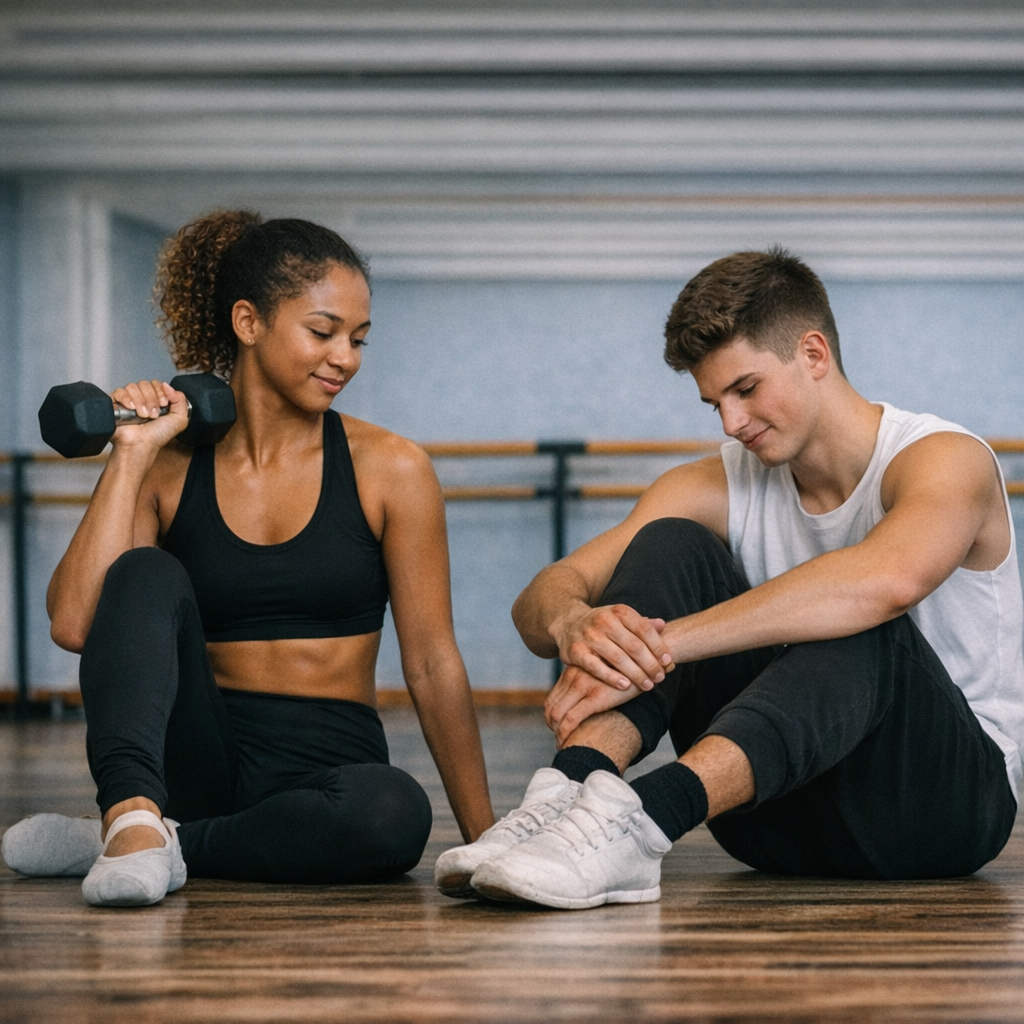
When dancers say “strength training,” they sometimes picture bodybuilding, heavy lifting only, or training that competes with technique. In practice, dancer‑relevant strength work is usually about building capacity and control—so dancers can meet choreography demands, maintain alignment under fatigue, and reduce overuse risk.
In the episode with the Dance USA Task Force on Dancer Health, Dr. Rosa Pasculli and Dr. Emma Faulkner emphasize that the biggest barrier is often not the value of strength training—but the myths and misunderstandings that keep dancers from using it effectively.
Why the myths persist (even when evidence and experience have moved on)
Many dancers inherit ideas that were never grounded in physiology—just tradition. As Dr. Pasculli puts it: “The myths about cross-training and strength training for dancers, they need to go, it’s 2025.”
That doesn’t mean teachers or parents are “bad” for repeating them—many were taught the same things. But it does mean that if we want healthier, more sustainable careers (and fewer preventable injuries), we need updated language, updated expectations, and better tools.
Strength training doesn’t make a dancer “bulky” overnight
The “bulky” fear is one of the most common reasons dancers avoid strength work—especially in adolescence. But Dr. Pasculli addresses the gap between fear and reality clearly: “Why are we still telling our dancers if they pick up a barbell, they’re going to walk out of the gym looking like Arnold Schwarzenegger?”
She also points out what it actually takes to build significant muscle size: “Bulking up… takes a lot of food, a lot of rest, supplements, tons of protein… specific training parameters. ” The practical takeaway for dancers, parents, and teachers is this: dancer‑appropriate strength training is typically not designed for mass gain. It’s designed for strength, stability, coordination, and repeatability—especially under fatigue.
“Will I lose flexibility?” (A more helpful way to think about it)
A common experience for dancers starting strength training is temporary tightness—especially when new loading patterns are introduced. That sensation often gets interpreted as “I’m losing flexibility,” when what’s really happening is that the nervous system is adapting to new demands and learning control.
The Dance USA conversation directly pushes back on the idea that strength automatically costs flexibility. Dr. Pasculli notes that early sensations can change as adaptation happens, and that strength and flexibility can coexist when training is structured well.
A dancer‑friendly way to reframe it is: it’s not just about having range; it’s about owning range. Strength training can support flexibility by improving active control, stability, and confidence at end range.
“Dance class should be enough.” (Why it often isn’t)
This is where dance science becomes especially helpful. Many dancers train high-volume, but the intensity and stimulus profile of dance technique is not the same as targeted strength and conditioning.
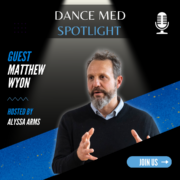
In the conversation with Dr. Matthew Wyon, he explains this using an “engine size” analogy. Dancers don’t need to train like power‑sport athletes. They often need only a modest “upgrade”: “We need to see a slight increase in engine size… but we don’t need to get up to… what I call grunt sports.”
He also emphasizes that meaningful gains can happen without huge time commitments: “We’ve seen benefits of doing two half hour… one hour a week session a week.”
This matters for scheduling, especially for teens and pre‑pros. If your week is already packed, the goal is not “add three more hours.” The goal is small, targeted work that supports what dance alone doesn’t fully train.
A practical minimum: “something beats nothing”
If strength training feels intimidating or overwhelming to add, it helps to start with a minimum effective dose. Kendall Baab gives a simple and realistic benchmark: “Even if it’s 30 minutes once a week, great. If it’s twice a week, even better.”
That framing is especially helpful for:
- busy teen dancers balancing school + training
- adult dancers balancing work + dance
- studio owners trying to introduce change gradually
- teachers who want to encourage strength without overwhelming students
The goal is consistency, not perfection.
Strength training is not “extra”—it’s preparation for choreography demands
One of the most persuasive shifts for dancers is connecting strength work to what choreography actually requires. In the Dance USA episode, Dr. Emma Faulkner gives a clear example of why “light weights only” doesn’t match real demands: “You’re going to have to pick up a woman over your head… I can assure you every one of our dancers… is going to weigh more than 40 pounds.”
She also emphasizes that dancers need to respond to unpredictability: “Dumbbells don’t move. People do.”
This is a powerful point for teachers and directors: strength isn’t only about whether a dancer can execute a lift once—it’s about repeatability, adaptability, and safety across rehearsals and performances.
“Cross‑training” vs “conditioning”: why words matter
Dancers often choose dance‑adjacent training (more dance styles, Pilates, yoga), which can absolutely be valuable. But it doesn’t always fill the gaps that dance medicine providers commonly see in injury patterns.
Drs. Pasculli and Faulkner describe cross‑training as training the body in different patterns, not simply doing “more of the same.” They also describe building resources that dancers can use anywhere, including structured follow‑along workouts designed to be realistic within a dance schedule.
This is a helpful educational point for teens and parents: if the goal is resilience and injury reduction, it often requires at least some training that looks different from technique class.
Why anatomy-informed training helps dancers “access” strength
Strength training isn’t just “work harder.” For dancers, it’s often about learning how to recruit the right systems for the job.
In Cara Dixon‘s discussion of Relative Motion’s approach, she describes a common issue: dancers try to “figure it out visually,” copying shapes instead of integrating body awareness.
She also emphasizes a useful distinction: “We don’t want you to grip… We want you to activate… lengthen, elongate, find space… but also make that muscle powerful enough to really accomplish what we’re asking.” For dancers, that difference is everything. It’s the bridge between “I’m working hard” and “I’m working efficiently.”
What this looks like in real life (simple implementation)
Here’s a practical, dancer‑friendly way to implement this without overhauling everything:
For dancers
- Start with 1–2 sessions/week
- Keep sessions short (20–40 minutes)
- Pick 3–5 foundational movements and repeat them
- Progress slowly and track how you feel
For teachers/studio owners
- Normalize that strength supports dance (not competes with it)
- Build consistency by aligning cues across styles
- Consider adding a short recurring block (even 10–15 minutes) where possible
- If adding strength class isn’t feasible, provide a recommended “minimum” plan
For parents
- Encourage realistic expectations: strength is gradual
- Look for programs that emphasize quality and progression, not extremes
- Support recovery: sleep and fueling are part of the equation
Closing thought: the goal is a longer, healthier relationship with dance
The throughline across these conversations is not “do more.” It’s: train smarter so dance can remain sustainable. That matters for teens, professionals, educators, and everyone supporting dancers.
If strength training feels like a risk, that’s understandable. But when it’s dancer‑informed, appropriately dosed, and linked to real movement demands, it becomes less about fear and more about support.