6403 S. Uvalda St. Suite 300-D, Centennial, CO | (inside The Performance Shift) | Direct Voicemail: (303) 960-2075 | Email: info@backinsteppt.com
Back In Step Physical Therapy
  • Welcome
  • Dance Medicine Services
  • Testimonials
  • Resources
    • Dance Med Spotlight Podcast
    • Blog
    • Our Dancer’s Kit
    • eBooks
  • Contact
  • Media
  • Click to open the search input field Click to open the search input field Search
  • Menu Menu
  • Link to Facebook
  • Link to Instagram
  • Link to Youtube

Tag Archive for: arm pain

Dancers’ Arm Movement & Shoulder Pain

November 6, 2019

The shaping and flow of the arms in dance helps to:

  • add complexity to lines of movement,
  • communicate a story without words,
  • contribute to both the beauty and strength of most styles of dance,
  • and much more.

Because arm movement is so crucial to most styles of dance, we tend to do a LOT of repetitive movement, between practice and rehearsals, shows, performances, and competitions.

Think about your average ballet warm-up at the barre – during a plie combination alone, how many arm movements do you do?

In the classes that I took growing up, we probably did a minimum of 30-40 movements per arm just in that one section alone! Multiply that by the various aspects of a barre warm-up, working at center floor, time spent going across the floor, running choreography, and a cool-down. A single hour-long ballet class likely has hundreds of movements per arm.

How often have you felt like your shoulders and arms are getting tired during class? During rehearsal? During performances? Or maybe you’ve experienced pain in the shoulders as the muscles fatigue from all of the repetition and holding of positions?

I know that that was a reality for me sometimes. So what can you do about it? Luckily, the answer is easy – you have a lot of options!

But first, let’s talk about WHY this happens in the first place.

We have several muscles all around the uchest & shoulder dance anatomypper arm and torso that contribute to movement. These include muscles like the deltoids, biceps, triceps, latissimus dorsi, and several others. Possibly even more importantly, there are multiple muscles around the shoulder blades that play a key role in the movement and stability of the arms. The muscles around the shoulder blades are the rhomboids, trapezius, serratus anterior. There are also four muscles of the rotator cuff that are important – infraspinatus, supraspinatus, subscapularis, and teres minor.
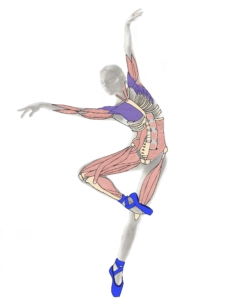
Here’s why the muscles around the shoulder blades are so important.

Think of it this way: when you’re building a house, the foundation needs to be strong and sturdy. If it’s not, then the house built on that foundation is liable to collapse. Those shoulder blade muscles are like the house foundation.

These muscles must be strong and working together in the appropriate ways. That way, when you are doing all of your different arm positions and movements, the arm itself doesn’t have to work so hard, strain is reduced, and things don’t fatigue as quickly. And, on the flip side, if those muscles around the shoulder blades don’t do their jobs correctly, the muscles of the arm have to work hard, meaning that it’s more likely to develop pain and fatigue.

So What Can You Do?

Like I said before, there are things that can be done to improve that foundation! The approach requires a combination of tactics, including mobility, stability, and strength, and working in that order is a great way to do it. Click each of the links to see the video of the exercise in action!


It’s important to know that the best plan of attack is customized for each person individually, but I still wanted to share some ideas for you to try. 


Mobilitypec stretch at the door
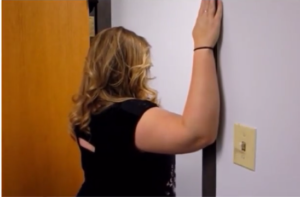
  • Pec Stretch – This stretch is easy to do at any doorway or corner of the wall. It helps to stretch out the muscles at the front of the shoulders and chest, allowing you to open up the chest more easily while you do various arm movements and positions.
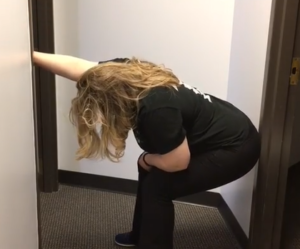
  • Lat Stretch – If you ever have trouble keeping your arms overhead without arching your back, this is a great stretch for you! This targets all kinds of muscles around the trunk, ribs, and shoulder, helping with all kinds of things.
Stability
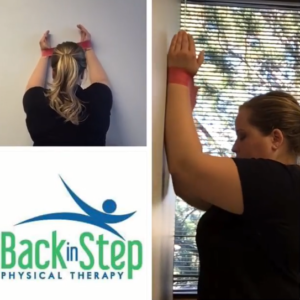
  • Wall Crawls – All you need is a wall and a resistance band to strengthen some of the muscles around the shoulder and shoulder blade. It helps to build a strong foundation, making it easier to keep your arms strong and stable while you dance!
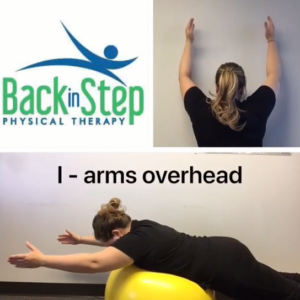
  • I, Y, T’s – The wall crawls exercises focuses a bit more on the rotator cuff, whereas this group of exercises targets the stabilizers of the shoulder blade. Another great way to build a strong foundation.
Strength
  • PNF D1 & D2 – This group of exercises builds upon the stability that you’ve gained with the previous exercises. Now, you are using more resistance and moving through larger motions. These exercises have a great connection to some of our dance technique, particularly if you’re doing something like partnering.


If you’ve tried these & still are having trouble with shoulder pain or controlling your arm movement, contact us to get an appointment & get checked out!

Also check our our Dancer’s Kit!
Shoulder or Back Pain? Keep Reading!

June 5, 2019

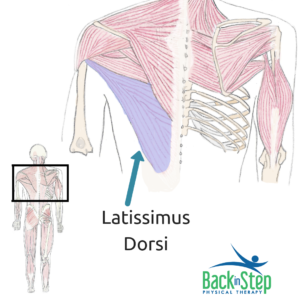
When you’re experiencing pain in the shoulder or in the back, there are a lot of things that can be contributing to it. An evaluation with a physical therapist can help assess what all is playing a role in your pain. One structure that can be involved with BOTH areas is a large muscle called the latissimus dorsi.

The Anatomy & Function

The latissimus dorsi (lat) spans a large area across the back, originating from various points throughout the pelvis and low back (at the spinous processes of T7-L5, the thoracolumbar fascia, the iliac crest, and inferior 3-4 ribs). It then inserts at the intertubercular groove of the humerus (near the shoulder on the upper arm bone). It is the largest muscle in the upper body. The innervation is from the thoracodorsal nerve (C6-8).

latissimus dorsi

It helps in many different motions or actions, including shoulder extension (moving your arm behind you), shoulder adduction (bringing your arm across your body), and arm internal rotation (rotating your palm towards your body). The lat also assists with several other motions at the shoulder and helps to support and move at the spine.

If the latissimus dorsi isn’t doing its job, it can contribute to arm or shoulder pain, low back pain, decreased range of motion and function of the arm, and more. It can also make it difficult to pull something towards you. Lastly, it can also affect how you can do exercises like pull-ups, lat pull-downs, rows, and deadlifts.

What to Do About It⠀⠀⠀⠀⠀⠀⠀⠀

We’ve got a couple of options to share with you – both a stretch and a strengthening exercise.

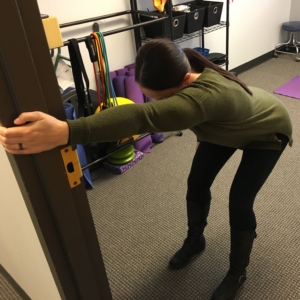
Lat Stretchlat stretch
  • Stand with your feet hip width apart or even slighty wider.
  • Hold on to the door frame with your thumb pointing up towards the ceiling. Hand should start around chest height.
  • Lean your hips back, like you’re trying to squat or sit back in a chair.
  • To vary the stretch:
    • Place your hand higher or lower on the door frame.
    • Before sitting back into the stretch, rotate your body so that you’re facing your arm slightly, or so that your arm crosses slightly in front of your body. Then sit back.
Lat Strengthening
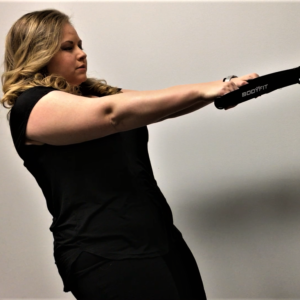
lat pulldown start
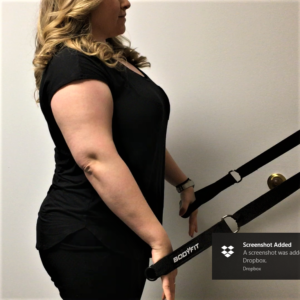
lat pulldown finish


There are several different pieces of gym equipment that can be used for this exercise. However, one of my favorites is the TRX. It adds a dynamic balance component and works the core and hip stabilizers even more than some other options. Here’s how to do it:

  • Stand with your feet shoulder width apart.
  • Hold on to each of the TRX straps, arms in front of you and straight. Elbows do not need to be locked out in a straight position, however.
  • Lean back, keeping your core engaged with spine and pelvis in neutral.
  • Pull your hands down by your side, while keeping your body in this plank position.
  • Make sure that you don’t let the shoulders hunch or roll forward as you come up to an upright position. Keep your shoulder blades pulled back and down to avoid this compensation!

Try these exercises and let us know how they work for you! They are two ways to try to combat shoulder or back pain. If you still have pain, give us a call and we can help get you back on track.

Do you have other things that you want to learn more about? Check out other blog posts and our Instagram page.

DISCLAIMER: The purpose of this site is to promote understanding of health, wellness, and prevention. The information on this site is not intended/implied to be a substitute for professional medical advice, diagnosis, or treatment. If you are experiencing pain, please see a medical professional.

Archive

  • May 2026
  • April 2026
  • March 2026
  • January 2026
  • December 2025
  • November 2025
  • October 2025
  • September 2025
  • July 2025
  • June 2025
  • May 2025
  • April 2025
  • March 2025
  • February 2025
  • January 2025
  • December 2024
  • November 2024
  • October 2024
  • September 2024
  • August 2024
  • July 2024
  • June 2024
  • May 2024
  • April 2024
  • March 2024
  • February 2024
  • January 2024
  • December 2023
  • November 2023
  • October 2023
  • September 2023
  • August 2023
  • July 2023
  • June 2023
  • May 2023
  • January 2023
  • December 2022
  • June 2021
  • May 2021
  • March 2021
  • December 2020
  • September 2020
  • December 2019
  • November 2019
  • June 2019
  • May 2019
  • October 2018
  • April 2018
  • January 2018
  • December 2017
  • November 2017
  • September 2017
  • July 2017
  • June 2017
  • May 2017
  • April 2017
  • January 2017
  • October 2016

Back In Step Physical Therapy

Located inside The Performance Shift,

6403 S. Uvalda St, Suite 300, Centennial, CO 80111

(303) 960-2075
info@backinsteppt.com

Check out our YouTube channel!

https://www.youtube.com/watch?v=d1jhdHKq8Qc

Recent Blogs

  • Bethany Shum – Flexibility Matters
  • Conditioning for Dancers: Why Dance Class Isn’t Enough
  • Shane Wuerthner – Athletistry
  • Strength Training for Dancers: Rethinking Dance Conditioning
  • Kristen Schuyten – The Performing Arts PT
© Copyright 2017-2025, Back In Step Physical Therapy. All Rights Reserved.
  • Link to Facebook
  • Link to Instagram
  • Link to Youtube
Scroll to top Scroll to top Scroll to top