Pain in Dance Training: What’s Normal and What’s Not
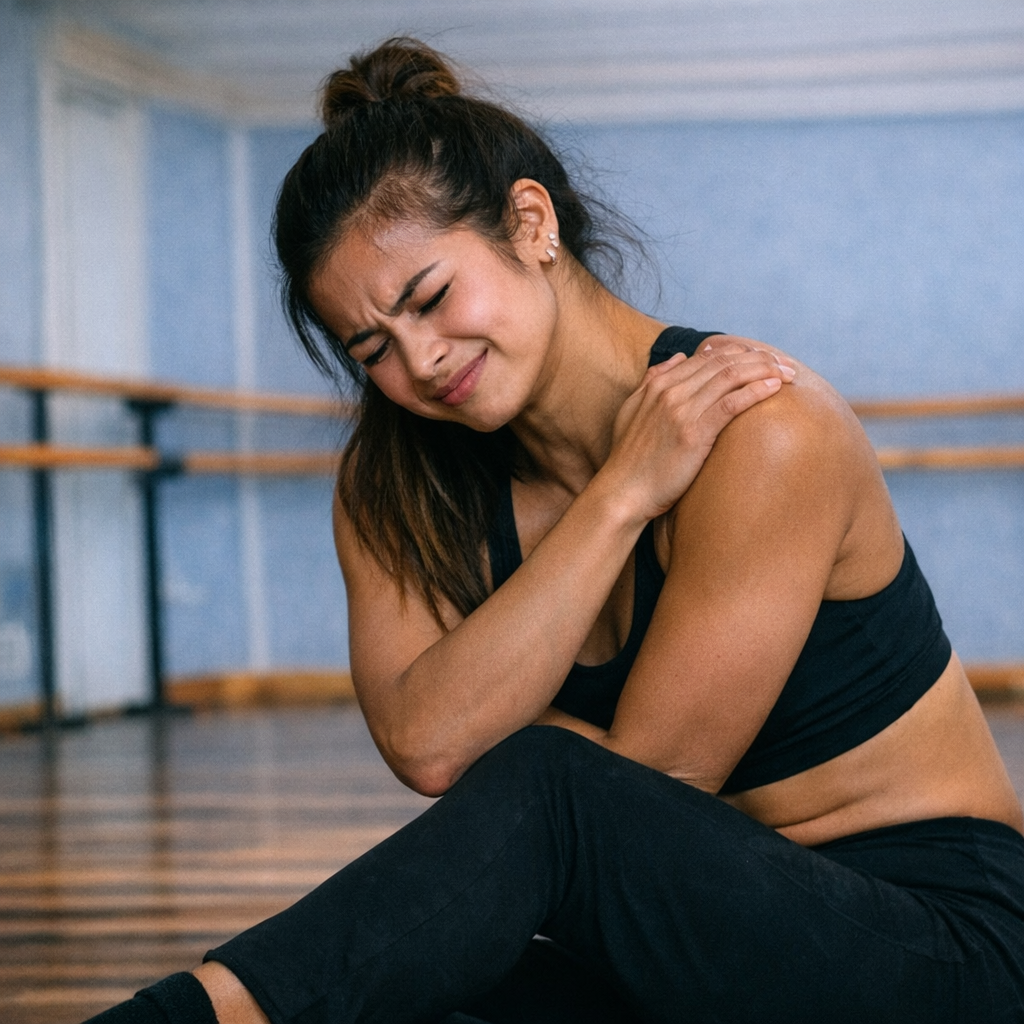
Pain in dance training is often normalized. Many dancers grow up believing that discomfort is just part of improving—but not all pain is productive or safe. Dance involves effort, challenge, and at times discomfort. However, pain is not always a sign of progress, and pushing through it is not always the right choice. Understanding how to interpret pain in dance training can help dancers avoid injury, improve performance, and build a more sustainable career.
This post brings together perspectives from dance medicine clinicians, researchers, and educators who have been guests on our podcast, Dance Med Spotlight, including insights from this month’s episode. Their perspectives help clarify how pain fits into dance training—and how interpreting pain more accurately supports dancer health, performance, and longevity.
1) Why pain in dance training is often misunderstood
Many dancers are taught to push through discomfort. Over time, that message becomes part of training culture. As a result, pain is often ignored instead of evaluated. This mindset can make it difficult to recognize when something is actually wrong. It also reinforces the idea that stopping, modifying, or asking for help is a weakness.
Alexandra Beller argues that dance culture often rewards “pushing through,” and that rest and recovery should be valued as part of training—not treated as weakness.
That doesn’t mean dancers should fear all discomfort. It means we need better language and better guidance, so dancers can tell the difference between “this is hard work” and “this is a warning sign.”
2) How pain in dance training can be misleading
Dancers often describe having “high pain tolerance.” That can be true. But it can also make it easier to miss patterns that matter (especially in high-volume training).
According to Bethany Shum, chronic pain isn’t defined by how “tough” someone is—it’s defined by time and persistence. She notes: “If you live with pain three months, it doesn’t go away. That is a chronic pain condition in itself.”
She also describes how beliefs shape perception: if someone believes “no pain, no gain” is simply part of performance life, they may push through pain even when it’s no longer healthy for tissue.
A practical takeaway here: instead of only asking “how bad is it?”, dancers (and teachers/parents) can look for patterns:
- When did it start?
- Is it changing?
- Does it rise after training or the next day?
- Does it limit range or function?
Those answers are often more informative than a pain number.
3) Fatigue and pain in dance training
A big reason dancers struggle to interpret pain is that fatigue blurs the signal. When dancers are exhausted, sore, and under-recovered, everything feels “louder.”
According to Leah Bueno, the cost of high-volume training isn’t just performance quality—it’s injury risk. She says, “if you’re exhausted, you will not perform your best. If you’re exhausted, you are going to have more injuries, your body is going to break down.”
This matters for teens, competitive dancers, and pre-pro schedules especially: the body may not “fail” in one dramatic moment—it may just slowly stop recovering well, then start hurting more often.
4) When pain in dance training gets dismissed as “just tightness”
One of the most common patterns across dance and circus conversations is the “I’ll just stretch it” loop—especially when pain starts subtle.
According to Emily Scherb, this is exactly how certain injuries stay around for years. In her words: “Cause they’re like, oh, I’ll just stretch it. It feels really tight. And then three years later they’re like, why does my hamstring still hurt?’” She follows it with a clear recommendation: “If… it’s not getting better, go get care.”
This is such an important performer reminder: if something persists or keeps returning, it’s worth a check—even if it’s not a dramatic injury.
5) Nervous system sensitivity can amplify pain (especially in hypermobility)
Pain isn’t only about tissues. It’s also influenced by the nervous system—sleep, stress, hydration, and the overall “volume knob” of the system.
According to Mandy Blackmon, people with hypermobility are often more sensitive, and chronic pain can become part of the pattern because the body is working overtime to create stability. She explains: “their muscles are working on overtime, trying very hard to hold their joints together and to give them some kind of stability.” This can contribute to chronic pain patterns.
This isn’t meant to label dancers as fragile. It’s meant to help dancers and teachers understand why pain sometimes doesn’t match the “size” of an injury—and why quality rehab often includes both strength and nervous system regulation.
The simplest rule that keeps coming up: “If in doubt, just check it out.”
Even with better awareness, there will be times where it’s not clear what a pain signal means—and uncertainty alone can change how a dancer moves.
According to Bethany Shum, the most practical approach is simple: “If in doubt just check it out.”
Getting something checked doesn’t automatically mean stopping everything for weeks. Sometimes it means:
- reassurance
- a modification plan
- a few targeted exercises
- preventing compensation patterns from building
What dancers (and the people supporting them) can do this week
For dancers
- Track patterns (start time, duration, next-day response), not just intensity
- Notice function changes (range, stability, coordination, “I can’t do what I usually can”)
- Treat persistent pain like information—not a badge
For teachers/studio owners
- Normalize early check-ins (before pain becomes a crisis)
- Reinforce that rest and modification are professional skills, not weakness
- Help dancers build language beyond “it hurts / it’s fine”
For parents
- Ask about patterns (“When does it happen? What changes it?”)
- Give permission to modify (especially during heavy rehearsal blocks)
- Support recovery basics (sleep, fueling, hydration)
Closing thought
Dance training will always involve effort. But pain doesn’t have to be a rite of passage.
The more dancers learn to interpret pain clearly—and the more the culture supports those conversations—the more likely dancers are to train consistently, recover well, and stay in dance for the long term.