6403 S. Uvalda St. Suite 300-D, Centennial, CO | (inside The Performance Shift) | Direct Voicemail: (303) 960-2075 | Email: info@backinsteppt.com
Back In Step Physical Therapy
  • Welcome
  • Dance Medicine Services
  • Testimonials
  • Resources
    • Dance Med Spotlight Podcast
    • Blog
    • Our Dancer’s Kit
    • eBooks
  • Contact
  • Media
  • Click to open the search input field Click to open the search input field Search
  • Menu Menu
  • Link to Facebook
  • Link to Instagram
  • Link to Youtube

The Rhomboids – It’s Not Geometry

June 19, 2019

When you first hear the term “rhomboid”, it might be a flashback for you in geometry class. In this case, we’re talking about a couple of muscles that help up with shoulder movement and stability, but you wouldn’t be far off with the shape. The muscles really are rhombus-shaped – just check out the diagram below to see for yourself!

These muscles are important for good shoulder function and stability. Keep reading to learn more!

The Anatomy & Function

The rhomboids are actually two muscles that attach the shoulder blade and the spine. Rhomboid major (the larger one that sits lower) attaches from the spinous processes of the T2-T5 vertebrae to the medial border of the scapula. Rhomboid minor sits a little higher, attaching from the nuchal ligaments and spinous processes of C7-T1 to the medial border of the scapula.  Both muscles are innervated by the dorsal scapular nerve (C4-5).
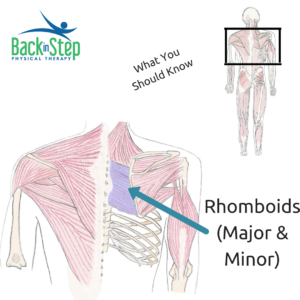
rhomboid muscle group

Both muscles also help to pull the shoulder blade back and helps to downwardly rotate it. They also fixes the scapula to the thoracic wall. 

Weakness or dysfunction of the rhomboids can contribute to shoulder pain or upper back pain. It will also impact how well the shoulder and arm can work, especially with things like getting something down from a kitchen cabinet, doing push-ups, or starting your lawnmower. The rhomboids also help to stabilize the shoulder, so if you ever feel like your arm isn’t as stable when it’s out away from your body, this could be an important muscle to focus on.

What to Do About It

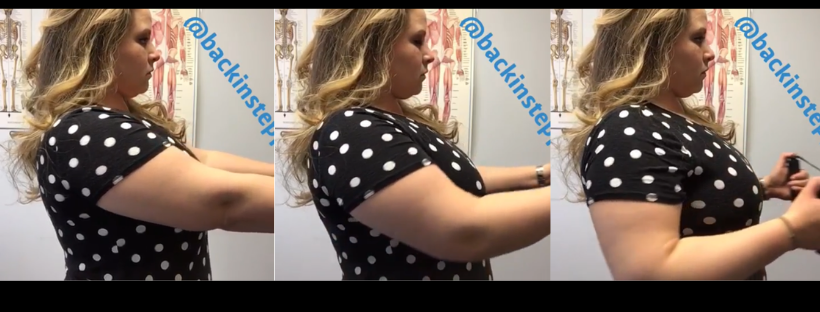
Here’s a couple of great exercise variations to work both the rhomboids and the posterior deltoid. They are possible to do without using the rhomboids so well, so make sure that you’re focusing on pulling those shoulder blades back with each repetition. Each repetition should be slow and controlled. Avoid shrugging your shoulders or arching your back.

Version #1: Standard low rows. Keeping elbows closer to the body, start with your arms in front of you. Keep your shoulders down throughout the motion. Initiate by squeezing the shoulder blades back and then pull your elbows back. Avoid pulling back so far that your shoulders start to roll forward.

Version #2: High rows. Still keeping the shoulders down, keep your elbows out to the side, not quite at 90* from your body.

Check out the video on our Instagram feed here.

DISCLAIMER: The purpose of this site is to promote understanding of health, wellness, and prevention. The information on this site is not intended/implied to be a substitute for professional medical advice, diagnosis, or treatment. If you are experiencing pain, please see a medical professional.

Share this entry
  • Share on Facebook
  • Share on X
  • Share on WhatsApp
  • Share on Pinterest
  • Share on LinkedIn
  • Share on Tumblr
  • Share on Vk
  • Share on Reddit
  • Share by Mail
You might also like
infraspinatus Rotator Cuff Strength is Important!
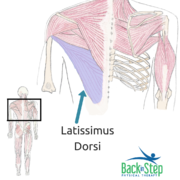
latissimus dorsi Shoulder or Back Pain? Keep Reading!
healthy dancer Dancers’ Arm Movement & Shoulder Pain

Archive

  • March 2026
  • January 2026
  • December 2025
  • November 2025
  • October 2025
  • September 2025
  • July 2025
  • June 2025
  • May 2025
  • April 2025
  • March 2025
  • February 2025
  • January 2025
  • December 2024
  • November 2024
  • October 2024
  • September 2024
  • August 2024
  • July 2024
  • June 2024
  • May 2024
  • April 2024
  • March 2024
  • February 2024
  • January 2024
  • December 2023
  • November 2023
  • October 2023
  • September 2023
  • August 2023
  • July 2023
  • June 2023
  • May 2023
  • January 2023
  • December 2022
  • June 2021
  • May 2021
  • March 2021
  • December 2020
  • September 2020
  • December 2019
  • November 2019
  • June 2019
  • May 2019
  • October 2018
  • April 2018
  • January 2018
  • December 2017
  • November 2017
  • September 2017
  • July 2017
  • June 2017
  • May 2017
  • April 2017
  • January 2017
  • October 2016

Back In Step Physical Therapy

Located inside The Performance Shift,

6403 S. Uvalda St, Suite 300, Centennial, CO 80111

(303) 960-2075
info@backinsteppt.com

Check out our YouTube channel!

https://www.youtube.com/watch?v=d1jhdHKq8Qc

Recent Blogs

  • Kristen Schuyten – The Performing Arts PT
  • Dance Med Spotlight: Top Episodes of 2025 & All-Time Favorites
  • Rosa Pasculli & Emma Faulkner – Dance/USA
  • Ann Hunt – Colorado Dance Education Organization (CoDEO)
  • Cara Dixon – Relative Motion Dance
© Copyright 2017-2025, Back In Step Physical Therapy. All Rights Reserved.
  • Link to Facebook
  • Link to Instagram
  • Link to Youtube
Link to: Rotator Cuff Strength is Important! Link to: Rotator Cuff Strength is Important! Rotator Cuff Strength is Important!infraspinatus Link to: Dancers’ Arm Movement & Shoulder Pain Link to: Dancers’ Arm Movement & Shoulder Pain healthy dancerDancers’ Arm Movement & Shoulder Pain
Scroll to top Scroll to top Scroll to top